
Why your mini split has ice on it in an Idaho winter
Why does my mini split have ice on it in winter?
Idaho winters run cold for months, and your mini split keeps working through all of them to heat the house. You step outside to check on the outdoor unit and find it coated in ice, frost climbing over the coils. A little frost is normal for a heat pump in the cold. A thick layer that is not melting is the kind of thing you'd rather catch now than wait on.
A thin frost is normal. Thick ice that doesn't melt means the defrost cycle isn't working.
Your mini split pulls heat from the outside air even when it's cold, and in the process the outdoor coil can frost over. The system is built to handle this. It runs a defrost cycle every so often, reversing briefly to melt that frost off before going back to heating. A light coating that clears on its own during that cycle is nothing to worry about. Ice that builds up and stays, especially in thick, solid layers covering the coil or fins, means the defrost cycle isn't kicking in the way it should. That can come from a stuck reversing valve, a bad sensor, a low refrigerant charge, or a fan that isn't moving air the way it needs to. Left alone through a long Idaho winter, it can block airflow entirely and strain the compressor.
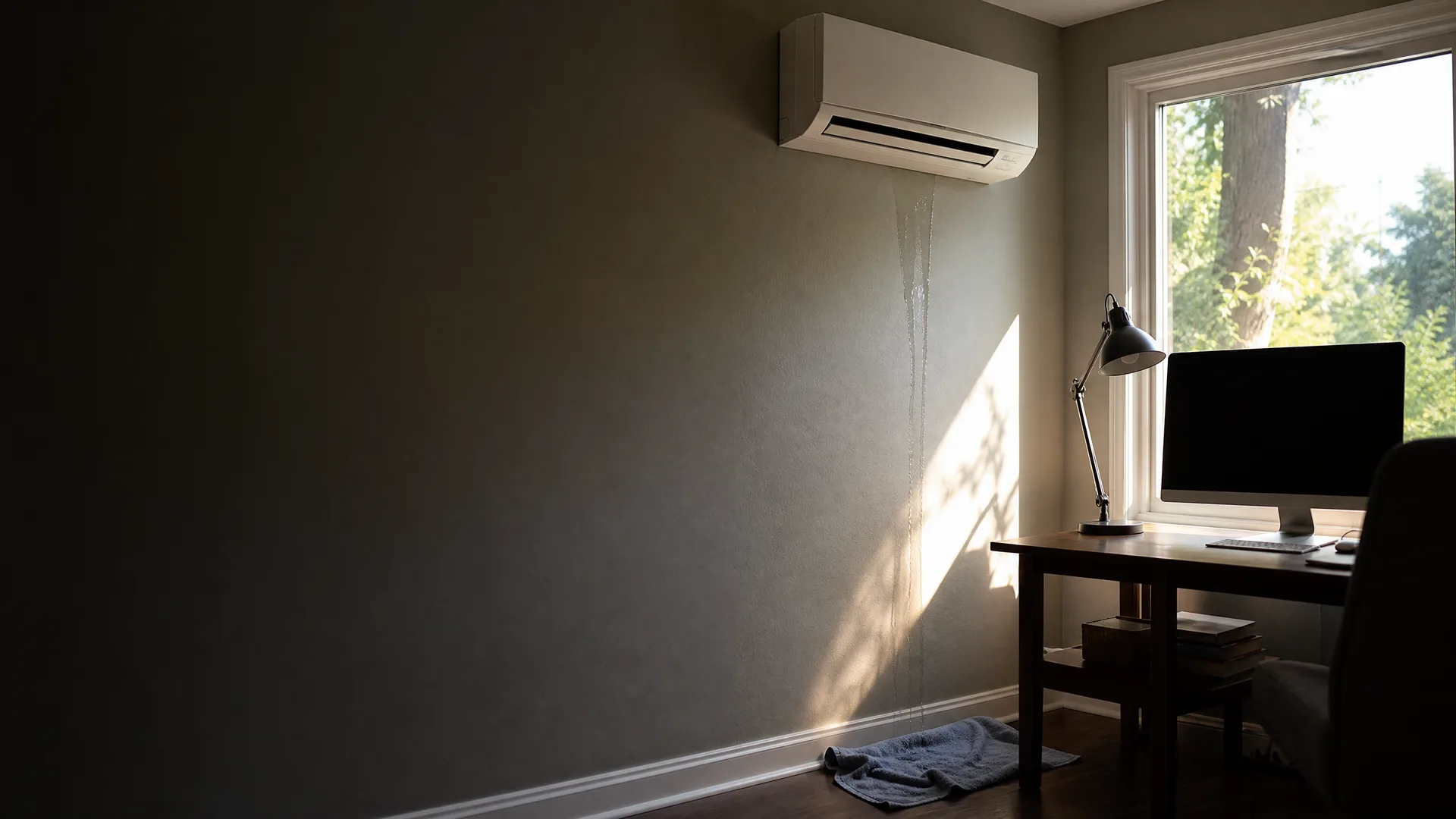
You're at your desk in the home office on a July afternoon, the kind of dry Idaho heat that makes the mini split run nonstop. You notice the wall under the indoor unit looks dark. Then you see the streak, water tracking down the drywall toward the baseboard. You already grabbed a towel and laid it on the floor where the drip lands. The unit is still blowing cold air, still sounds fine, but the wall is wet and you don't know how long it's been like that. You check your phone for the time, like it matters. The towel is soaked through in under an hour.
Normal Frost or a System That Needs a Look
Normal Frost
- A thin layer of frost across the outdoor coil during a defrost cycle clears on its own within ten to fifteen minutes.
- The unit pauses heating, runs in reverse briefly, and you may hear a change in sound or see steam rise off the coil as the ice melts.
- This happens on its own schedule through cold, damp stretches and is how the system sheds normal ice buildup without help.
- Once the cycle finishes, the coil looks clean again and the indoor unit keeps heating the house like nothing happened.
Ice That Won't Quit
- Ice that stays put for hours, thickens, or spreads up the lines and onto the unit's housing means the defrost cycle isn't doing its job.
- A dirty outdoor coil blocks airflow enough that the unit can't shed frost the way it's built to, so ice keeps layering on.
- Low refrigerant charge drops the coil temperature further than it should go, and the result is ice that builds faster than any defrost cycle can clear it.
- A failed defrost sensor or control board can stop the reversing cycle from firing at all, leaving the coil to ice over through the whole cold stretch.
- If the outdoor fan isn't turning or is running slow, the coil can't get the airflow it needs to melt off, and ice sets in around the blades.





Idaho summer air is dry. The dew point averages 42°F across June, July and August, a number that comes from NOAA climate data, and that's low. It's part of why your mini split doesn't labor through summer the way it does through a cold Idaho winter. Icing isn't a summer problem here. It builds when the outdoor unit runs for hours straight in freezing temperatures, pulling moisture out of cold air until frost forms faster than the defrost cycle can clear it. If the ice isn't gone within fifteen minutes or it's building up again soon after, that's a sign something isn't defrosting right. Send the form and you're done hunting for someone to look at it.
NASA POWER T2MDEW county cells weighted by homes
Hand off the search today
A thick coat of ice on your outdoor unit that won't clear on its own means the defrost cycle isn't doing its job, and a mini split can't heat your home efficiently while it's fighting ice instead of running normally. Left alone, that ice spreads, the coil stays blocked, and the system works harder for less heat in a house that's counting on it through an Idaho winter. Figuring out why defrost isn't clearing it takes someone who can look at the reversing valve, the sensors, and the fan motor and tell what's actually failing. That's not a call list you want to be making room temperature in your house, trying to find a contractor who works on mini splits, explaining the ice and the sound it makes and how long it's been doing this, then doing it again for the next name on the list. Send the request once and that search is off your plate. The ice on your unit still needs a look, but finding who looks at it doesn't have to be yours to sort out anymore.
How the defrost cycle works
Your mini split checks the outdoor coil temperature on a timer, usually every thirty to ninety minutes depending on the system. When the coil drops cold enough to grow frost, the unit reverses the refrigerant flow for a few minutes, sending warm gas through the outdoor coil to melt it off. The indoor fan slows or stops during this so you don't feel cold air blowing inside. A sensor on the coil tells the control board when the frost is gone, and the system switches back to heating. That whole exchange depends on the sensor giving an accurate reading and the reversing valve moving fully each time.
Where the cycle breaks down
A sensor that's drifted out of calibration can tell the board the coil is warmer than it actually is, so defrost never triggers even as ice builds. A reversing valve that's sticking might start the cycle but not fully switch, so warm gas never reaches the coil. Low refrigerant changes the coil's temperature pattern enough to throw off the timing too. Idaho's cold snaps push the system through more defrost cycles than a mild winter would, which means a borderline sensor or valve gets more chances to fail. A unit that iced over once in January and cleared fine can fail the next cold stretch if one of these parts has started to go.


What's Actually Failing on the Board
- A failed defrost sensor keeps the system reading the coil as warm, so it never triggers the reversing cycle at all.
- A stuck reversing valve can trap the unit in heating mode even after the control board calls for defrost.
- Low refrigerant charge drops the coil temperature further than normal, so frost forms faster than the defrost cycle can clear it.
- A blocked outdoor fan, jammed by ice or debris, stops the warm air that's supposed to help melt frost during defrost.
- A dirty or iced-over coil loses surface area, so even a working defrost cycle can't clear it fast enough.
- Once the board logic misreads the coil as clear, the compressor restarts heating mode while ice is still sitting on the fins.
Every mini split handles defrost the same basic way. A sensor clipped to the outdoor coil reports its temperature to the control board, and the board decides when ice has built up enough to run a defrost cycle. When that sensor fails, it can stick on a reading that tells the board the coil is warm, so the board never calls for defrost at all. Frost builds unchecked because the system never thinks there's a problem to fix.
The reversing valve is the other common point of failure. It's what switches the system from heating to defrost and back, and when it sticks, the board can call for defrost and the valve just doesn't answer. The compressor keeps pushing heat the same direction it always does, and the coil keeps icing over outside.
Low refrigerant charge makes the whole cycle work against itself. With less refrigerant moving through the coil, it runs colder than it's supposed to, so frost forms faster than a normal defrost cycle is built to clear. A blocked outdoor fan, jammed with ice or leaves, cuts off the warm airflow that's supposed to help melt frost during the cycle. And a coil that's already thick with dirt or old ice loses surface area, so even when defrost fires on schedule, it can't keep up.
The failure that does the most damage is quieter than the rest. If the board misreads an iced coil as clear, it kicks the compressor back into heating mode while ice is still sitting on the fins, and the system keeps running that way until something gets checked.
Power costs 11.83 cents per kilowatt-hour statewide
Running the defrost cycle more often during a bad ice spell doesn't hit your bill the way it would in other states. At 11.83 cents per kilowatt-hour, keeping that mini split clearing ice through an Idaho winter costs less than it would almost anywhere else.
EIA-861 2025 statewide residential average
A little frost that clears on its own in ten or fifteen minutes is your mini split doing what it's built to do. Ice that stays, spreads, or keeps coming back after the cycle ends is a sign something in the defrost control, the sensor, or the charge isn't working right, and it won't fix itself. That's the one thing to remember walking away from this: normal frost clears, bad ice doesn't. If what's on your outdoor unit matches the second one, the next step is getting a contractor out to look at the sensor, the reversing valve, or the refrigerant level before a cold snap turns it into a bigger repair. You don't have to spend the next hour searching for someone local, calling around to see who answers, explaining the same problem over and over, or sitting on quotes trying to compare them. Send the details once and let someone else carry the job of finding the right contractor for your mini split.





Hand off the mini split problem
Fill out one short form instead of calling around.
You're not committing to anything by asking.