




What size mini split an Idaho home needs

Say what's going on with your mini split, and a pro who works on them reaches out.

Step 1 of 3: Equipment

Sizing depends on your home's square footage, its insulation, how many windows face the sun, and the layout you're cooling or heating. A single-zone mini split typically covers somewhere between 300 and 1,000 square feet per indoor unit, depending on its rating in BTUs. A room with a lot of west-facing glass in an Idaho summer needs more capacity than a shaded bedroom the same size. Bigger isn't automatically better: an oversized unit cools the room fast then shuts off, leaving it clammy, while an undersized one runs constantly and still can't keep up on the hottest afternoons. Since most homes here heat with gas, the mini split is likely doing cooling duty most of the year and maybe some shoulder-season heating, which changes the calculation from a home that leans on it for winter heat too. A contractor measures the actual space, not just the square footage, before landing on a size.

A smiling bearded man in a dark green hooded jacket and blue t-shirt sits on a couch in a living room with shelves, a potted plant, and a bowl of popcorn on a wooden table.
A smiling man in a green long-sleeved shirt sits on a beige sofa in a living room, with a bowl of popcorn in the foreground, a large potted plant and shelving behind him.
A smiling man in a dark blue T-shirt sits on a couch in a dimly lit living room with a bowl of popcorn and a remote on a wooden table, a lit floor lamp and bookshelves behind him, and windows showing greenery.
A smiling bearded man in a dark green long-sleeved shirt sits on a leather couch in a living room, with a bowl of popcorn and a remote control on a wooden table in the foreground.

Undersized vs. Oversized Mini Split

Undersized unit

  • It will run flat out on the hottest July and August afternoons and still struggle to pull the room down to temperature.
  • Short cycling isn't the risk here, the opposite is: it runs continuously and wears the compressor harder over the dry summer stretch.
  • A single zone pushed past its rated square footage leaves rooms at the far end of the layout noticeably warmer.
  • Because power is cheap in Idaho, the extra runtime costs you less here than it would elsewhere, but the comfort gap stays.
  • It won't dehumidify well either, since a unit sized too small spends its time chasing temperature instead of cycling normally.

Oversized unit

  • It cools the room fast, then shuts off before it's pulled moisture out of the air, which matters less here since Idaho summers run dry.
  • Short cycling wears the compressor through constant stopping and starting rather than steady operation.
  • Rooms near the indoor unit get cold while rooms farther away barely feel it, since the blast of air satisfies the thermostat before the space evens out.
  • It costs more to install than the unit your square footage actually calls for.
  • On mild spring and fall days it cycles on and off rapidly instead of running a longer, steadier stretch.
A white wall-mounted mini-split indoor unit high on a beige interior wall, with a potted olive-like tree at right and an armchair and window visible through a doorway at left.

Right size, running easy

A properly sized mini split cycles on, pulls the room down, and shuts off. The coil behind that white cover stays clean because the system isn't fighting a losing battle all afternoon. Set it and leave it, even when the sun's hitting that side of the house hard.


A wall-mounted mini-split air conditioner indoor unit with visible dust and staining, installed on a beige interior wall below white crown molding.

Wrong size, showing it

A unit that's too small never really stops working, so dust and grime build up fast around the vents and casing, like you see here. It's straining nonstop through July and August, pulling in air constantly, and that grime is the evidence of a system sized wrong for the room.

How do I know what BTU mini split I actually need?

You've seen the 300 to 1,000 square feet per indoor unit range, but your living room isn't a generic box. You want a number you can actually use before a contractor shows up, not just a range to guess inside of.

Get a room by room load calculation, not a square footage chart

A contractor sizing your mini split runs a Manual J load calculation. It takes your square footage and adds what the chart can't: how many windows face west and catch the afternoon sun, how much insulation is in the walls and attic, the ceiling height, and how many people use the room. Two homes at 500 square feet can need different BTU output once you factor in a wall of west-facing glass versus a shaded north room. Skip the calculation and you're guessing between a 9,000 and 18,000 BTU unit with no way to know which one actually matches the room. The contractor who installs it is the one who should run these numbers before the unit gets ordered.

  1. A contractor measures every room and checks window and wall exposure

  2. That load calculation sets the BTU number for each zone

  3. Indoor head size and location get matched to that number

  4. The outdoor unit's capacity gets sized to cover all heads combined

A white wall-mounted mini-split air conditioner unit installed high on a beige interior wall below white crown molding, with a window and woven shade at the left edge showing green foliage outside.
A mini split sized right for your square footage cools the room and shuts off, even when Boise's hitting 95 in the shade.
A dusty, stained white wall-mounted mini-split air conditioner indoor unit installed high on a plain off-white interior wall near the ceiling.
A unit too small for the space runs nonstop all summer, and that dust and discoloration is the coil losing the fight.
A woman in a dark gray sweater reclines on a couch with her eyes closed and a knit blanket over her lap, an open book resting face-down in front of her, with a lit table lamp and shelving blurred in the background.
A bearded man in a dark navy sweater over a collared shirt smiles and looks off to the side while seated at a dinner table with a glass of red wine, a lit candle, and a plate of food in the foreground of a dimly lit room.
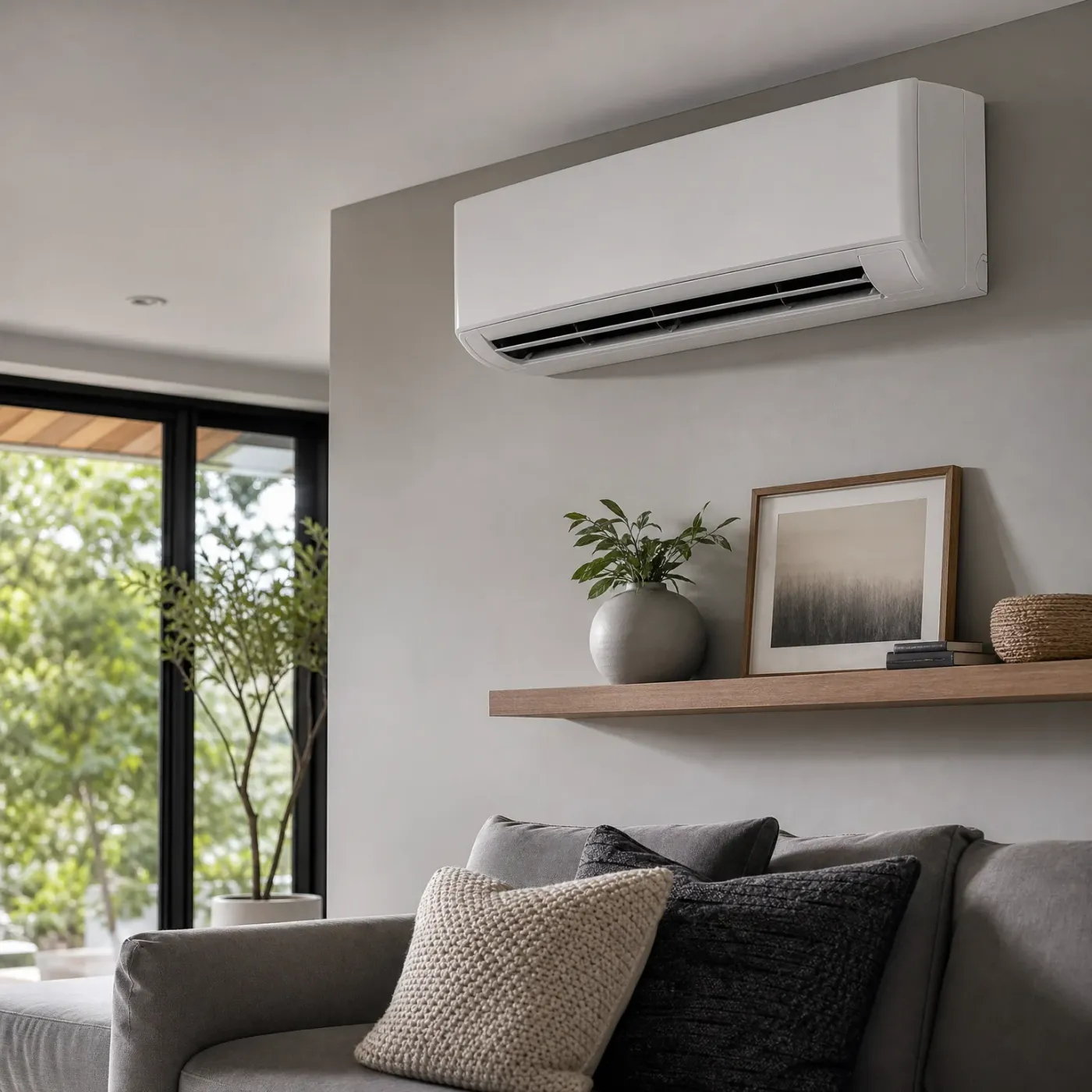
A white wall-mounted mini-split air conditioner near the ceiling of a living room with a gray sofa, knit cushions, a wooden floating shelf holding a plant in a round vase, a framed print and a woven basket, and a large window showing green trees.

Get the right pro for your mini split

One request and the search for a pro is handled.

A local pro who knows mini splits gets your details and gets in touch.

Send my request

There's no charge for the request.

Power costs 11.83 cents per kilowatt-hour statewide

At under 12 cents a kilowatt-hour, running a correctly sized mini split through a hot Idaho summer won't hit your wallet hard. Size it right and the savings hold. Oversize or undersize it, and you're just burning that cheap power to fight a losing battle.

EIA-861 2025 statewide residential average

A white wall-mounted mini-split air conditioner on a beige interior wall, with a window at left showing trees and a wooden fence, and dark wood flooring below.

Sized right, working quietly

The indoor unit cycles on, pulls the room down, and shuts off. No straining, no running past the point where the room's already comfortable. The coil behind that cover stays clean because it isn't working overtime every afternoon.

A white wall-mounted mini-split air conditioner indoor unit with dark louvered vents, installed near the ceiling on a beige wall below white crown molding.

Sized wrong, showing it

Dust and discoloration build up on a unit that never gets a break. That's a mini split sized too small for the room, running long hours it shouldn't have to. The louvers and casing wear faster when the system can't ever just shut off.

A man in a dark blue shirt stands in an open front doorway of a stucco and wood-clad house, facing a blond woman seen from behind in the foreground on a stone walkway.

Get the size wrong and you'll feel it by August

A mini split that's too small for your living room won't just run longer. It'll run the whole afternoon and still leave the room a few degrees warmer than you set it. You'll notice it most on the days you actually need it, when it's hot enough that the dry air stops helping and the unit is the only thing standing between you and a miserable evening. Too big, and it cycles on and off so fast it never pulls the moisture down, so the room feels clammy even though the thermostat says you're fine.

Either mistake is hard to undo once the lines are run and the outdoor unit is bolted down. That's the case for getting someone out to measure your rooms and your windows before anything gets installed, not after. A contractor who sizes it to your actual house, not a square footage range, is the difference between a system you forget about and one you fight with every July. Submitting your information gets that measurement started, and from there it's someone else's job to get the number right.

Interior corner of a dining room with a round wooden table, a ceramic vase holding olive branches, a dark spindle-back chair near a curtained window, and a sideboard with a lamp against beige walls.
A two-story cream-colored house with horizontal siding and a gray hipped roof, flanked by large green trees and shrubs, with a concrete walkway crossing a lawn to a wet street in the foreground.

Idaho summers are dry, and that changes what a mini split is actually fighting. The average summer dew point here is 42°F, which is low. Dry air gives up heat faster than humid air does, so a correctly sized unit isn't also wringing moisture out of the room all afternoon. That's a lighter job than the same system would face in a humid state. But an undersized mini split doesn't get that break. It still has to move enough heat out of a dry 95 degree room, and running flat out in dry heat wears the compressor the same way. Size it to the square footage, not the humidity.

NASA POWER T2MDEW county cells weighted by homes

Why does one room never quite cool down?

If your mini split is undersized for the room, you'll notice it most in the back bedroom or the addition, the space the indoor unit was never really sized for. The thermostat says it's close to set point, but the air coming off the head feels lukewarm by mid afternoon. The outdoor unit runs for hours without shutting off. Check the coil behind the indoor unit's cover: if it's caked with dust or shows dark streaking, that's a unit that's been running flat out for a long stretch, not cycling the way it should. Left that way through another Idaho summer, the compressor is doing more work than it was built for, and that shortens how long it lasts.

A white wall-mounted mini-split air conditioner indoor unit with visible dust and staining along its lower vent, installed on a plain pale wall.
Before you get your mini split installation
A white wall-mounted mini-split indoor unit installed high on a gray interior wall, with a window at left and part of a light gray sofa with a dark cushion at lower right.
After you get your mini split installation

Getting the size right

  • The right BTU number comes from a load calculation, not from square footage alone.
  • Idaho's dry heat means a correctly sized unit cools the room without also fighting humidity.
  • An undersized unit runs all afternoon and still leaves the room a few degrees warm.
  • An oversized unit cycles too fast and never settles into a steady, even temperature.
  • A contractor who measures the room and checks its sun exposure gets the number right the first time.
  • Once you send the form, matching you with that contractor is no longer something you have to chase down.

Square footage gets you in the right neighborhood, but it's the load calculation, the room measurements, the window exposure, the layout, that gets you the actual BTU number. That's the whole point of everything above. Idaho's dry summer air works in your favor here. A correctly sized unit spends its time pulling heat out of the room, not wringing moisture out of it, so it reaches set point and shuts off instead of running the compressor into the ground. Get the size wrong in either direction and you feel it. Too small and the unit runs all afternoon in July and August and still leaves the room a few degrees warm, especially in that back bedroom or addition it was never quite matched to. Too big and it cycles on and off too fast, never settling into a steady temperature, and the room ends up clammy even though the air's dry outside. Right size, on the other hand, just runs quietly in the background. A contractor who actually measures the room and checks which walls face the sun is how that number gets set correctly before the unit ever goes in, rather than guessed at and corrected later. Once you send the form, that part stops being your problem to manage. You're not the one tracking down a contractor or sitting on hold. The matching happens, and someone who installs mini splits for homes like yours gets in touch.

A lit ceramic table lamp with a linen shade sits on a round wooden side table with a small vase of greenery and a dark shallow bowl, beside a beige upholstered sofa with a cushion and knit throw, below a framed artwork on a pale wall.
Corner of a beige linen sofa with a large woven cushion and a fringed knit throw, beside a potted leafy tree in a woven basket against a neutral wall.
Sunlit interior corner with a wood-framed armchair with beige cushions and a striped pillow, a leafy plant in a tall ceramic pot, a window with wood sill showing green foliage outside, and dark wood flooring.
A lit black path light beside a stone walkway leading to a dark front door of a white clapboard house, with shrubs and flowering plants in the bed at dusk.
A covered porch at dusk with a wooden front door, a lit lantern wall sconce on gray horizontal siding, a black rocking chair with a cream throw, a potted white flowering plant, a coir doormat, and a window showing a lit interior lamp.

A pro who works on mini splits

Send it once and finding someone is no longer on you.

Get a mini split pro

You only hire the pro if you want to.