What defrost mode means on an Idaho mini split

Step 1 of 3: Equipment

Defrost mode is your mini split pausing heat to melt ice off its outdoor unit. In an Idaho winter, the outdoor coil can drop below freezing while it pulls heat from the air, and moisture in the air turns to frost on it. Once that frost builds up, the unit can't absorb heat properly, so the system reverses itself for a few minutes, runs like an air conditioner to warm the coil, and melts the ice off. You might see steam rise off the outdoor unit, hear the fan stop, or feel cool air inside for a short stretch. That's normal and it should pass on its own. What's not normal is defrost cycles that run long, happen over and over, or leave ice that doesn't clear. That points to a problem with the sensor, the reversing valve, or the refrigerant charge, and it's worth having someone look at it.

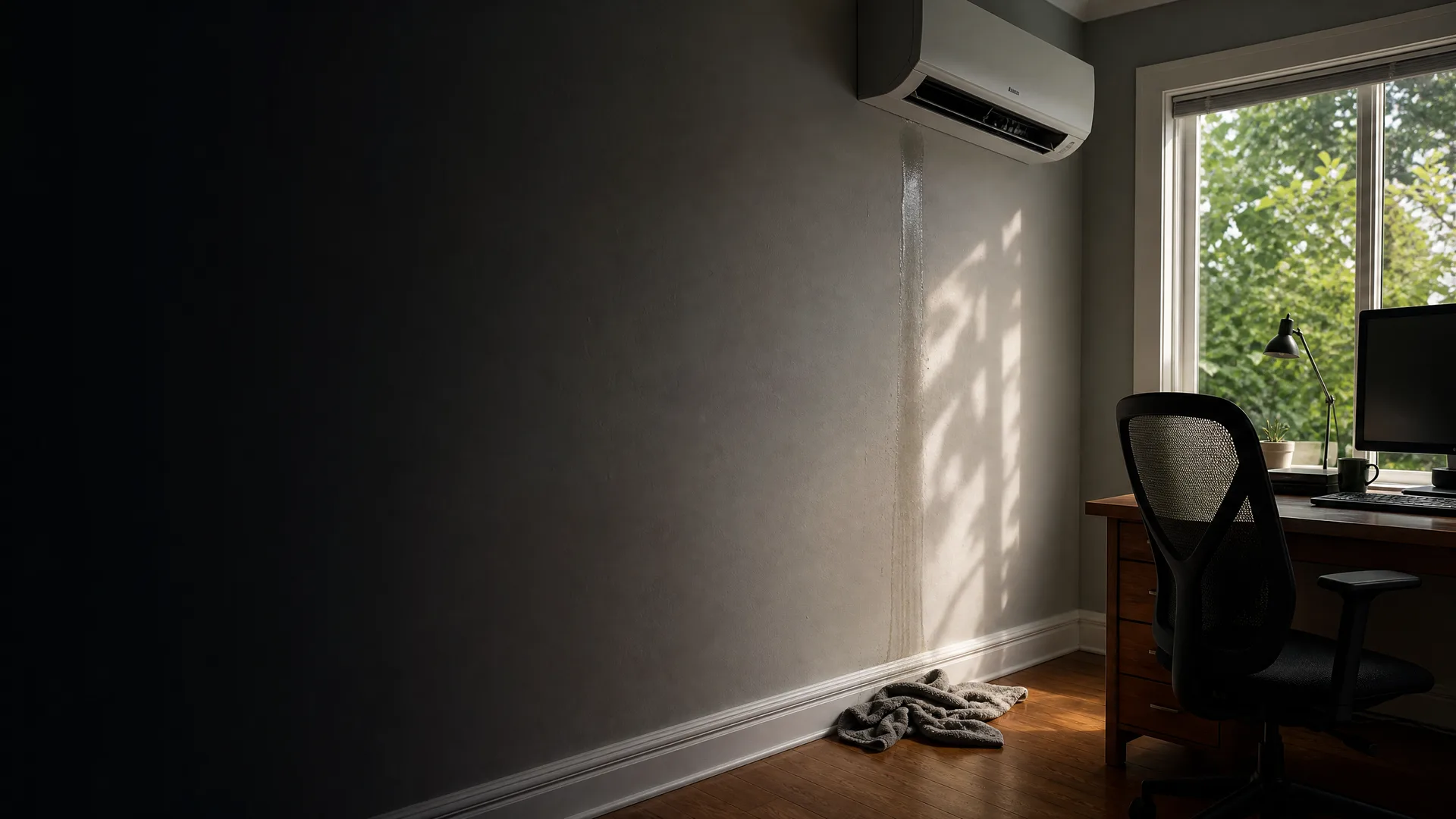
A wall-mounted mini-split air conditioner in a dim room, with a water streak running down the wall below it to a towel on the floor near the baseboard, beside a desk, office chair and monitor by a window.

It is July, mid-afternoon, and you are at your desk trying to work. You notice the wall first, a dark streak running down from under the indoor unit, soaking into the paint. Then the towel, already damp, that you threw down an hour ago when you first saw the drip. Outside it is hot and dry, the kind of Idaho afternoon that should have the mini split running nonstop, but the unit is quiet except for a faint hiss. You keep glancing up at it between emails, watching the streak get a little longer, wondering if you should shut the whole system off before it reaches the outlet behind your desk.

Why does my mini split blow cold air for a few minutes in winter?

You're running the heat on a cold night and the unit suddenly stops putting out warm air. For a few minutes it blows cold, or just blows air with no heat behind it, before it goes back to normal. It feels like something broke, especially when you're used to gas heat elsewhere in the house behaving nothing like this.

That's defrost mode running, not a malfunction

The outdoor unit switches briefly into cooling mode to warm up its own coil and melt the frost off it. That's why the air coming from the indoor unit turns cold for those few minutes. The fan outside usually stops too. Once the coil is clear, the system switches back to heating and warm air returns. On a cold, damp Idaho night this can happen more than once. It's normal behavior built into the unit, not a sign the system is failing. If the cold air lasts much longer than a few minutes, or the unit never switches back to heat, that points to a problem with the defrost sensor or control board rather than normal frost buildup.

A white wall-mounted mini-split indoor unit installed high on a gray interior wall, with a sofa, dark table and window visible in an adjoining room to the right.

Defrosting on schedule

This is what normal defrost looks like. The unit cycles out of heat for a few minutes, the fan may slow or stop, and warm air comes right back once the outdoor coil clears. No ice on the wall unit, no water where it shouldn't be, no noise that wasn't there last week.

A wall-mounted mini-split air conditioner indoor unit with a dusty beige casing and dark louvered vent, installed near the ceiling on a plain beige wall.

Stuck in the cycle

Dust and yellowing like this build up over seasons, and a dirty coil struggles to shed frost the way a clean one does. If defrost mode is running long or often, or warm air never comes back, the unit isn't clearing ice properly and the cold Idaho nights ahead will only push it harder.

A smiling man in a dark navy sweater sits on a light sofa in a living room, with a glass bowl of popcorn on a wooden coffee table and bookshelves behind him.
A smiling man in a dark green sweater sits on a tan leather sofa in a dimly lit living room, with a bowl of popcorn in the foreground and a kitchen area blurred behind him.
A smiling middle-aged man in a dark shirt sits on a gray sofa in a living room, with a bowl of popcorn on a side table and shelves, a window and kitchen area behind him.
A smiling bearded man in a dark gray t-shirt sits on a gray couch in a living room, with a large glass bowl of popcorn on a wooden table in the foreground.

30 to 40 minutes

A normal defrost cycle runs this long before your mini split switches back to heat. If it's stuck longer than that, something's keeping the coil from clearing.

I'm done searching

One sensor reading wrong

A failed defrost sensor or thermistor can't tell the outdoor coil it's clear of ice, so the unit keeps cycling or never comes back to heat at all.

I'm done searching

Normal Cycle or Repair Call

Normal defrost

  • The unit switches out of heat for a few minutes, usually 30 to 40, then switches back on its own.
  • The fan may slow down or stop completely while the coil clears, then picks back up.
  • Warm air returns once the cycle ends, and the room keeps the heat it had.
  • No water collects on the floor or wall, because the melted frost drains through the unit's own line.
  • This can happen more than once on a cold night without anything being wrong.

Needs a repair call

  • The unit stays in defrost past 40 minutes and never switches back to heat.
  • You see ice building up on the outdoor unit that doesn't clear between cycles.
  • Water is running down the wall or pooling under the indoor unit instead of draining outside.
  • The outdoor fan isn't turning at all, so the coil has no way to shed the frost.
  • Heat doesn't come back once defrost ends, or the air stays cold for longer than a few minutes.
  • The unit short cycles between heat and defrost over and over through the evening.
  1. Outdoor coil temperature drops and frost starts forming on it

  2. A sensor on the coil reads the temperature and tells the board

  3. The board reverses the valve, sending hot gas outside instead of in

  4. The outdoor fan slows or stops while the coil clears

A woman in a dark gray sweater reclines on a light sofa with eyes closed and a slight smile, under a textured gray blanket with an open book resting on her lap, with a lit table lamp and plant in the background.
A smiling bearded man in a navy crewneck sweater sits at a dinner table with a glass of red wine, plates and glasses in the foreground, in a dimly lit room with a lamp and framed picture behind him.

Let someone else find the pro

You already know what a stuck defrost cycle looks like at your place now, the cold blast that doesn't quit, the fan that won't come back, maybe ice building where it shouldn't. That's a sensor, a reversing valve or a control board, and none of those get fixed by waiting it out. Most Idaho homes lean on gas for heat, so a mini split acting up may not leave you without warmth, but it does leave you with a system that's not doing its job, running up a power bill that's usually cheap for no reason. Sorting that out yourself means searching for someone who works on mini splits, calling a few, explaining the cold air and the stuck fan over and over, then weighing quotes against each other while the unit keeps cycling wrong. Send the request instead and that part of it is off your plate. One contractor gets your situation, and finding them stops being something you have to do between everything else today.

A white wall-mounted mini-split air conditioner unit near the ceiling on a plain light-colored interior wall with open space to the right.

Running it through a cold snap

When Idaho temperatures sit in the teens or lower for days, your mini split goes into defrost more often, because the outdoor coil has more frost to deal with. That's normal. Each cycle still runs 30 to 40 minutes, then heat comes back. You'll notice more of these cycles on the coldest nights, but the pattern stays the same each time: heat pauses, fan slows, warm air returns.

A white wall-mounted mini-split air conditioner unit installed near the ceiling on a plain beige interior wall, with a light curtain at the right edge.

Running it through a mild one

On a milder winter day, above freezing but still cool enough that you're running heat, the outdoor coil picks up less frost. Defrost cycles happen less often, and some days you may not notice one at all. If your unit is still cycling into defrost every hour on a 45 degree afternoon, the coil isn't reading the outdoor temperature right, or something else is keeping frost from clearing the way it should.

What would you actually see if defrost got stuck

You'd notice it at the indoor unit first. Cold air instead of heat, running longer than the few minutes a normal cycle takes. The fan might keep blowing with nothing warm behind it, or stop and not come back. Outside, ice builds past the coil itself, creeping onto the case or the ground beneath it, instead of clearing the way it should. Left alone through a cold stretch, that ice can keep building until the outdoor fan can't turn or the coil takes damage. The room you're heating stays cold either way, and the unit keeps drawing power without giving you anything for it.

A white wall-mounted mini-split air conditioner unit high on a light gray interior wall, with a beige curtain and window at the left and wood-look flooring below.
This unit cycles through defrost on its own and goes back to heating without any sign on the wall or floor.
A dusty white wall-mounted mini-split air conditioner indoor unit with open louvers, installed near the ceiling on a plain light-colored wall.
Grime like this around the vents usually means the coil isn't draining right, and defrost may be stalling instead of finishing.
A single-story house with gray vinyl siding, dark shingled gable roofs, and white-trimmed windows, set behind a partly dry green lawn under a clear blue sky.

A summer dew point of 42°F is what the National Weather Service averages out for Idaho homes across June, July and August, and that's dry air. Defrost mode doesn't come into it at all in summer, since that's a winter problem on the outdoor coil. What dry summer air does is keep your mini split's cooling side working the way it's built to, pulling heat out without fighting the extra moisture units deal with in muggier states. Come winter, that same outdoor coil is where frost builds and defrost kicks in. Dry summers don't change how often that happens once the cold sets in.

NASA POWER T2MDEW county cells weighted by homes

A dusty, discolored wall-mounted mini-split air conditioner unit near the ceiling of a plain beige interior wall.
Before you get your mini split repair
A white wall-mounted mini-split air conditioner installed near the ceiling on a plain beige interior wall.
After you get your mini split repair

Before you get your mini split repair, you're checking the fan and the wall yourself every cold morning, calling around for someone who works on mini splits, and explaining the same stuck defrost cycle to each one.

After you get your mini split repair, that's done. You send one form, someone licensed to fix a reversing valve or a sensor takes it from there, and you're not the one chasing it anymore.

Power costs 11.83 cents per kilowatt-hour statewide

At 11.83 cents a kilowatt-hour, running your mini split's defrost cycles costs little either way. A stuck cycle that keeps the unit blowing cold and cycling on and off wastes power without heating your house, but the real cost is the part that's failing, not the electricity.

EIA-861 2025 statewide residential average

A closed silver laptop and a ceramic mug of dark coffee sit on a wooden table in front of two chair backs, with a kitchen counter, tiled backsplash, wooden cutting boards, a vase of greenery and a potted plant by a window behind.

So that's what defrost mode is

Defrost mode is your mini split clearing frost off the outdoor coil so it can keep heating your house. A normal cycle runs 30 to 40 minutes and ends on its own, heat comes back, and you never see ice on the wall unit or water where it doesn't belong. A stuck cycle means a sensor, a reversing valve or a control board isn't doing its job, and that's a repair, not something that clears up with time.

If what you're seeing at your place matches the stuck pattern, you don't have to spend your evening on it. No searching through contractor listings, no calling around to find someone who actually works on mini splits, no explaining the cold blast and the fan that won't come back to one shop after another. Send the form once and that part of the work is off your plate.

A gray upholstered sofa with a matching cushion sits beside a potted plant and a wooden table holding a small green plant in a stone pot, near a curtained window.
Dark standing-seam metal roofs of wood-sided buildings in the foreground, with a single spruce tree, grassy hills, conifer forest, and snow-streaked mountain peaks behind.

One request and it's handed off

Hand off my repair

You only hire the pro if you want to.

A stuck defrost cycle doesn't fix itself by waiting out another cold morning. Send the request and you're done checking the fan and the wall yourself, done calling around, done explaining the same problem twice. Someone who works on mini splits takes it from here.