Tell us about the job
Takes about a minute. No obligation.
A mini-split repair call in Bingham County arrives in a narrow window. Homes in Bingham County, ID run cooling in a single month of the year, July. The compressor, the condenser fan, and the contactor spend most of the calendar at rest, and long idle periods let refrigerant seep, capacitors weaken, and electrical contacts corrode without any load to reveal it. The first hot day triggers the first call, and what the contractor finds is usually a component that failed during the off-season and sat that way until someone turned the unit on. A repair scope here starts with the electrical side and the refrigerant circuit, not with parts worn down by heavy cycling.
Half the homes in Bingham County, Idaho were built in 1978 or earlier (2020-2024 ACS 5-year). When a mini-split develops a fault in stock like this, what the opened unit reveals depends heavily on what was already in the walls before the system went in. Refrigerant line sets, disconnect boxes, and branch wiring were often retrofitted into spaces designed for something else, and that retrofit work is what a contractor is actually tracing when a repair gets complicated. A wiring problem that looks straightforward on the spec sheet turns into a longer job once the panel and the branch circuit tell a different story than the indoor head does.
The Parts of a Mini-Split a Contractor Checks During Repair
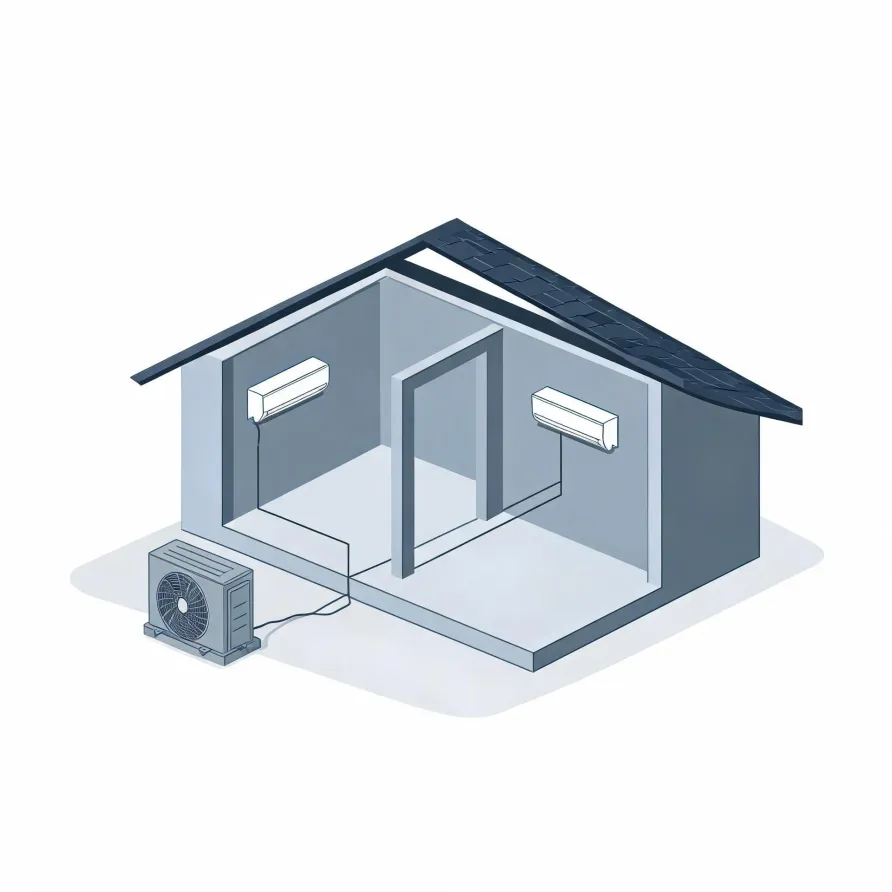
The indoor air handler mounts high on a wall inside the living space and is where most homeowners first notice a problem, whether that is reduced airflow, unusual sounds, or ice forming on the unit. It houses the evaporator coil, the blower wheel, and the condensate drain, any of which can be the source of a fault. The outdoor condenser unit, sitting on a pad or bracket outside the house, holds the compressor and condenser coil, and a failed compressor or refrigerant leak at this end often explains why the system stops conditioning air altogether.
A refrigerant line set runs between the two units through a small opening in the wall, carrying the refrigerant and the electrical connections that let them work together. The line set itself can develop leaks at the fittings, and the control wiring inside it is a point a contractor checks when the system powers on but behaves erratically. The condensate drain line, which carries moisture pulled from the indoor air to the outside, is a frequent source of water damage complaints when it becomes blocked.
The drawing beside this text shows the general layout of a mini-split system, and a licensed contractor determines which components apply and what condition they are in for your specific installation.
Get matched in Bingham CountyBingham County, by the numbers
258 severe weather events were recorded in Bingham County, Idaho between 2015 and 2024.
NOAA National Centers for Environmental Information, Storm Events Database, bulk CSV export, events 2015-01-01 through 2024-12-31.Half the homes in Bingham County, Idaho were built in 1978 or earlier (2020-2024 ACS 5-year).
U.S. Census Bureau, 2020-2024 American Community Survey 5-Year EstimatesBingham County, Idaho holds 17,528 housing units (2020-2024 ACS 5-year).
U.S. Census Bureau, 2020-2024 American Community Survey 5-Year EstimatesOwners occupy 80.5% of the occupied homes in Bingham County, Idaho (2020-2024 ACS 5-year).
U.S. Census Bureau, 2020-2024 American Community Survey 5-Year EstimatesRepair Rules and Codes for Mini-Split Work in Bingham County, Idaho1 sourced standards and rules
Licensing Rules for HVAC Work in Bingham County, Idaho
Idaho requires a state certificate of competency for heating, ventilation and air conditioning work: it is unlawful to engage in the business, trade or practice without passing the examination and holding the certificate.
Weather Stress on HVAC Equipment in Bingham County
Bingham County's climate puts real load on heating and cooling equipment year after year. A mini-split running hard through weather extremes accumulates wear that shows up as repair calls, and understanding that pattern is part of knowing what local service actually demands.
258 severe weather events, 2015–2024. Source: NOAA National Centers for Environmental Information, Storm Events Database.